
小时代
全球独角兽大会在港开幕 助力企业借港出海_我的网站

A | 香港8月24日电(谢妞)由香港大公文汇传媒集团主办的全球独角兽大会24日在香港会展中心开幕。
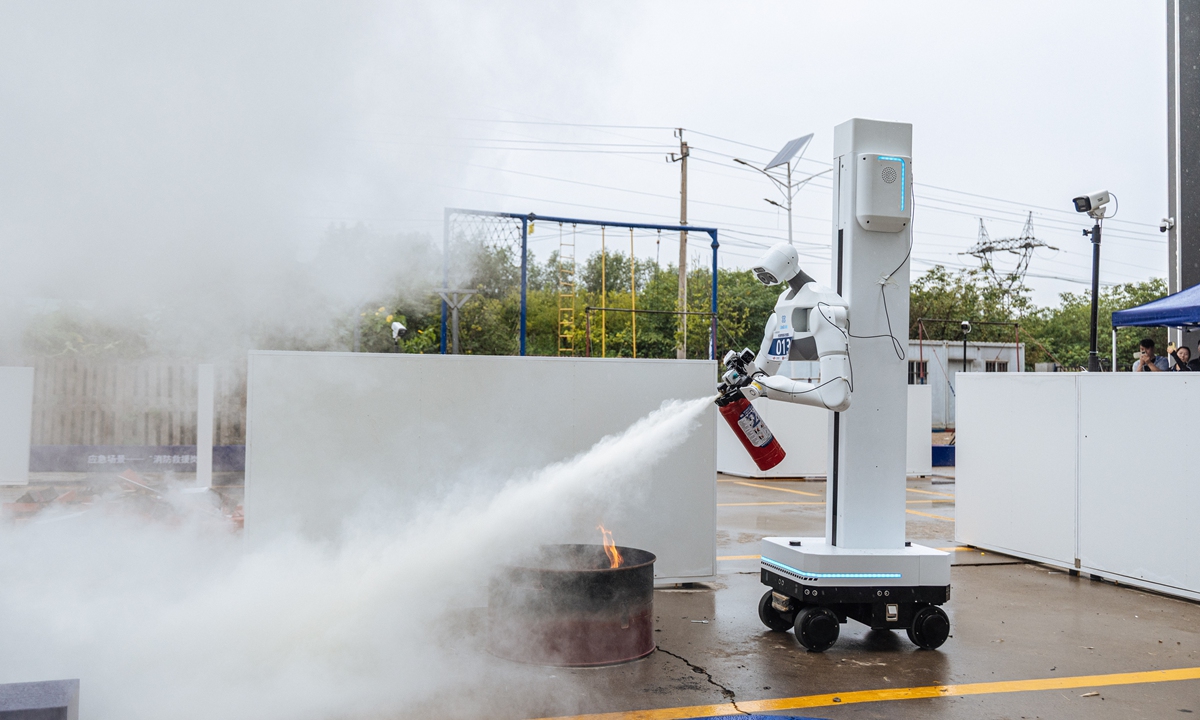
The firefighting final of the emergency management category at the 2nd World Humanoid Robot Games (WHRG) was held on Sunday in Beijing, putting 23 teams through a simulated rescue operation designed to test whether humanoid robots can move beyond demonstrations and perform practical tasks in complex real-world environments.
The event comes as Chinese humanoid robots, long known for eye-catching abilities such as running, dancing and music playing, are pushed toward practical applications, including jobs that are dangerous for humans such as emergency rescue.
Unlike the first edition of the WHRG last year, according to the organization committee, this year's scenario-based events emphasize "realistic simulation," with the firefighting competition being held at a fire brigade rather than in a model-room setup.
The competition simulated a firefighting assignment that required each of the 23 robots to complete three tasks within 30 minutes: identify hazardous materials, shut off valves and operate a fire extinguisher. For the first task, robots had to identify two randomly placed simulated hazardous substances and report their types to judges through returned images. They then had to locate three randomly selected open valves of different types and shut them off before identifying a fire source, finding a fire extinguisher and spraying it until the fire was put out.
Human firefighters were also involved in the event, lighting the fire and observing whether the robots carried out the extinguisher operation correctly.
The competition, however, showed how difficult it remains for robots to perform reliably outside controlled laboratory conditions.
Rain affected the competition, while changes in lighting and the outdoor environments added uncertainty to the robots' visual recognition and manipulation tasks. A team from UniX AI, a company well-known for its robot applications on real-world scenarios and has just raised a new round of 300 million yuan ($ 44.49 million) in late March, completed its run within the allotted time, but its robot moved relatively slowly compared to human firefighters' real practice. When operating the fire extinguisher, its robotic hand had to make two attempts to align with the target.
Of 12 teams competed on Sunday, three finished the challenge.
Yang Liqi, a representative of the UniX AI team, told the Global Times that the firefighting scenario placed higher demands on both the robot's recognition and manipulation capabilities.
"Rain and lighting conditions can affect the robot, and actual situations are often different from what we simulate in the laboratory," Yang said, noting that this was also one reason why a number of teams were unable to complete their runs on Sunday morning.
The team had programmed the robot to make up to three attempts when operating the extinguisher. "If it sees white smoke after the first attempt, it will not make a second attempt," Yang said.
The difficulty was not simply that whether the robot could move its arm. Humanoid robots rely on different types of joints for different tasks: small, high-precision joints enable delicate hand operations, while high-torque, reliable joints support movement and balance.
A failure at any point of actions and detection could affect the final result. This is precisely where the value of real-world competitions lies, Jin Chenran, a representative of the Tiangong team whose robot only accomplished one of the three tasks, told the Global Times.
"Whether the competition goes smoothly or not, that is the significance of a real-world simulation. Every real-world failure is valuable data that helps humanoid robots toward practical application," Jin said.
Jin further explained that questions like why the robot failed to recognize an object and how its motion-planning system selected the wrong path... Such data can subsequently be used to improve algorithms and train AI models.
The competition also offered a glimpse into the current transitional stage of humanoid robot technology. At the venue, some team members were wearing VR headsets and remotely adjusting their robots shortly before their runs.
Some humanoid robots were seen using omnidirectional wheels instead of feet, while their hands featured multiple joints to enable more precise manipulation. Many teams chose China-developed UBTECH's joint modules for their robots. Its servo actuators cover a wide torque range from 0.2Nm to 200Nm, allowing robots to combine dexterity with strength. Meanwhile, VR teleoperation gives operators a first-person view through the robot's cameras, enabling them to remotely guide movements in real time.
The event comes amid a broader push in China to move humanoid robots and embodied intelligence from laboratories and competition arenas into real production and daily-life environments. In June, the Ministry of Industry and Information Technology and the other departments launched a special program for humanoid robots and embodied intelligence that encouraged applications in practical fields including emergency rescue.
Zhao Weidong, deputy director of the organizing committee office, told the Global Times that the scenario-based competitions are intended to test the progress of humanoid robots from "competition performance" toward "real operational work," including whether they can eventually become intelligent partners for firefighters.
"At present, many simulations of actual operations may still be at an early stage," Zhao said. "But these are an important starting point for enabling robots to truly assist humans in real-world environments, as well as an important source of data and testing."
The ultimate goal, Zhao said, is to push robots into fields where human operations are dangerous and achieve genuine "human-robot complementarity."
。大会以“天生骐骥·创领未来”为核心主题,推动全球独角兽企业落户香港、来港上市、借港出海,助力香港国际创科中心建设。 据介绍,全球独角兽大会是面向全球独角兽企业、隐形独角兽企业、高成长科技企业、科研院所等的高端创科交流与投融资合作平台。本届大会聚焦人工智能、生物医药、金融科技等领域,打造“论坛、展览、路演、对接、竞赛”五位一体的多元互动场景,促进科技成果落地转化,推动战略新兴产业与未来产业跨区域协同发展。 开幕仪式上,香港特区行政长官李家超致辞表示,面对科技浪潮的加速迭代,香港更要培育壮大新兴产业和未来产业,完善产业创新、发展生态,为发展新质生产力带来庞大机遇。对于内地的初创和独角兽企业,香港是进军国际市场的最强跳板、布局全球供应链的战略支点;对于海外顶尖科创企业,香港是探索内地市场的首选枢纽、拓展中国机遇的黄金门户。 香港大公文汇传媒集团董事长李大宏表示,首届全球独角兽大会让各界共同见证一场汇聚全球创新力量,连接科技与资本、研发与产业的盛会。期待大会能成为各方合作的起点,更多企业成果从香港走向世界。 中国生物制药有限公司首席执行长谢承润表示,作为连接国家创新体系与全球市场的枢纽,香港具备深厚的研发优势、成熟的经营体系、开放的应用场景及完善的支付环境。面对粤港澳大湾区建设的战略机遇,香港必将进一步发挥全球独角兽生态“连接器”与“孵化器”的作用,释放巨大创新势能。 活动现场,深圳逐际动力科技有限公司展示其多款前沿产品,吸引众多参观者驻足交流。逐际动力董事会秘书及投资者关系负责人陈丰说,香港是国际金融和贸易枢纽,希望借助本次大会吸引更多海外客户,推动公司全球化业务迈上新台阶。 本届大会汇聚了200余家全球独角兽企业、100余家高成长科技企业、100余家投资机构及专业服务机构、50余家科研院校和政府部门。
Current article:http://wsd7.tandianxiuzhutiaoshoudiamei.pics/list_1ztyb45/6n2qv.html
Published on:02:01:11


1
618购物节来了!淘宝京东618活动最优惠时间段已确定:从6月17日晚8点至6月18日24点这28小时内最便宜划算!2
5100万引进!官方:31岁拜仁中场帕利尼亚加盟本菲卡,总价1900万3
650万人仍面临严重威胁 是否人为纵火?洛杉矶山火起因调查复杂繁琐4
前国足队长带队0-13惨败越南球队 47分钟丢9球 董路回应5
2026年张家界旅行社服务现状观察及地接资源梳理6
张帅首次晋级温网女双八强7
Photos: Saif Ali Khan and Karisma Kapoor Visit Deol Residence8
雷军详解新一代玄戒芯片原型机,包括高速 AI 演示终端和个人 AI 超级计算终端9
曝车灯上市公司星宇股份羞辱式劝退应届生:硕士被安排打螺丝,300 人被迫离职10
小米集团发布国内首款3nm智驾高算力AI芯片玄戒D10011
为什么人人都爱 Zork?《The Duskbloods》中最古怪的角色,也是宫崎英高的最爱12
央视曝光特大跨境荐股诈骗案 男子轻信荐股直播被骗近500万元13
【品种策略】锌:08月26日多家期货公司晨报观点汇总14
闲鱼仲裁偏袒买家,买家违约跑单,卖家独自承担30%退票手续费15
US says Iranian drones breach sanctions
- 随机推荐
1
BIG6主帅音乐偏好:瓜帅是酷玩乐队铁粉,阿莫林迷上《乡村路》2
Marigold oleoresin from Southwest China's Yunnan exported globally3
An Oklahoma man used pandemic relief funds to have his name cleared of murder4
RTX 3060 12GB复产两个月:价格疯涨14%!比RTX 5050贵还更慢5
EU slams sanctions on Iran's morality police, minister6
石达开亲信将领朱衣点,随石达开离京出走,后因何率部千里回朝?,泾蓝杂说,原创 石达开亲信将领朱衣点,随石达开离京出走,后因何率部千里回朝?7
再添穿黄“新动脉” 济南跨黄通道布局进一步完善8
哈登和库里的差距是怎么拉开的?而留给库里的时间还有多久?9
辽宁省总工会发布23项暖“新”清单10
Katrina Kaif Celebrates First Christmas As a Mom, Holds Vicky Kaushal Close in Adorable Picture11
双色球一等奖7注747万元,奖池6.28亿元12
Cybercab正式定档!自动驾驶赛道迎来新催化 这7股业绩倍增可期(名单)13
频准激光:上半年净利润8833.57万元,同比增长24.58%14
宇树科技连跌5日 股价跌破600元 市值较历史高点蒸发2000亿元15
泽连斯基承认骗了特朗普,称是被乌克兰国防部误导